
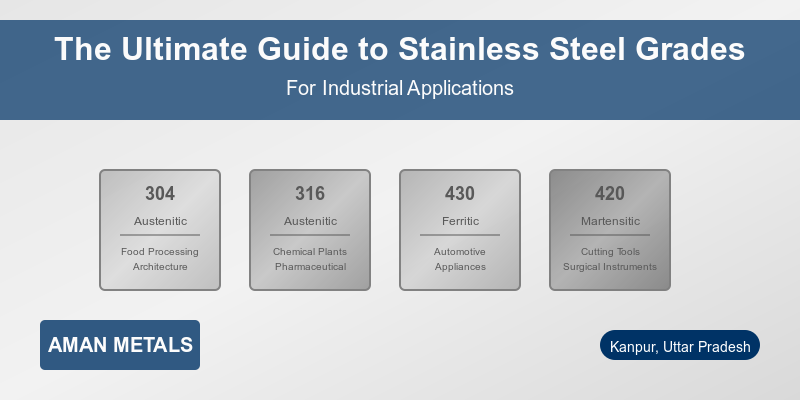
Stainless steel is an integral part of our everyday lives. It’s present in everything from kitchen utensils to the striking exteriors of contemporary architecture, and from critical components in chemical facilities to tools utilized in healthcare settings. Across India and globally, stainless steel serves as a vital element in numerous industries. At Aman metals, we have dedicated years to assisting businesses in Kanpur, Uttar Pradesh and beyond in selecting the ideal stainless steel materials tailored to their specific requirements. This thorough guide will walk you through the various grades of stainless steel, highlighting their unique properties and optimal uses, helping you make informed choices for your next project.
What Gives Stainless Steel Its "Stainless" Qualities?
To kick things off, let’s explore what makes stainless steel so special. The answer lies in its unique composition.
Stainless steel lives up to its name due to its impressive resistance to staining, corrosion, and rust, largely attributed to its chromium content—at least 10.5% by mass. This chromium forms a passive oxide layer that acts as a barrier, safeguarding the underlying metal from moisture, air, and aggressive substances. As noted by the Indian Stainless Steel Development Association, this protective layer is what endows stainless steel with its distinct properties and versatility across diverse applications
However, it’s crucial to understand that not all stainless steel is made the same. While they all share the fundamental characteristic of corrosion resistance, different grades provide varying degrees of:
- Corrosion resistance
- Heat resistance
- Strength and longevity
- Machinability
- Weldability
- Cost-effectiveness
Recognizing these distinctions is essential for selecting the right material suited to your project needs.
The Major Stainless Steel Grade Families
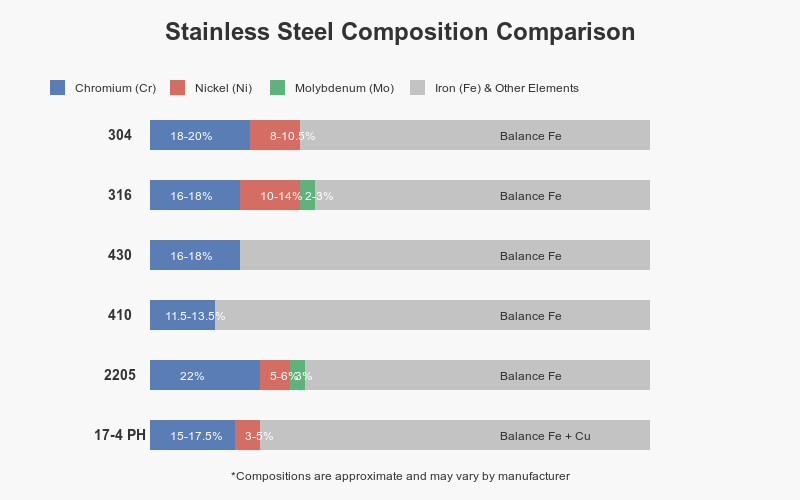
Stainless steels are broadly categorized into five families, each with unique properties and uses:
- Austenitic
- Ferritic
- Martensitic
- Duplex
- Precipitation Hardening (not covered in detail here, as it’s less common in general industrial use)
Let’s explore the most important ones for industrial applications in India.
Austenitic Stainless Steel (300 Series)
The austenitic family is the most widely used and recognized group of stainless steels. These grades are known for their excellent corrosion resistance, formability, and weldability.
304 Stainless Steel (18/8)
- Composition: ~18% chromium, 8% nickel
- Properties: Excellent corrosion resistance, good formability, and weldability. Non-magnetic in the annealed condition.
- Applications: Kitchen equipment, food processing, chemical containers, architectural features, sinks, machinery components, and more.
- Local Relevance: Widely used in Kanpur’s food processing industry and across Uttar Pradesh for general-purpose applications.
304 stainless steel is frequently referred to as the industry’s “workhorse” It’s the go-to choice for everything from cutlery to construction, thanks to its balance of performance and affordability.
316 Stainless Steel
- Composition: Similar to 304, but with added molybdenum (2-3%)
- Properties:Enhanced resistance to corrosion, particularly in environments that contain chlorides and acids.
- Applications: Chemical plants, coastal installations, pharmaceutical equipment and medical devices, food processing (especially for acidic foods or dairy).
- Local Relevance: Essential for pharmaceutical and medical equipment in Uttar Pradesh’s expanding healthcare sector.
316 is the grade of choice when you need extra protection against harsh chemicals or saltwater, such as in chemical processing plants or coastal architectural features.
Ferritic Stainless Steel (400 Series)
Ferritic stainless steels have a low nickel content or none at all, which makes them a more budget-friendly option compared to austenitic grades.They are magnetic and offer good corrosion resistance, especially in less aggressive environments.
430 Stainless Steel
- Composition: 16-18% chromium, very low nickel
- Properties: Good corrosion resistance, moderate formability, magnetic, cost-effective.
- Applications: Automotive trim, appliances, kitchenware, architectural panels, and more.
- Local Relevance: Popular among Kanpur’s automotive component manufacturers and appliance makers.
Ferritic grades like 430 are often used where cost is a concern and the environment is not too corrosive.
Martensitic Stainless Steel
Martensitic grades are known for their hardness and strength, making them ideal for cutting tools and applications where durability is critical.
420 Stainless Steel
- Composition: 12-14% chromium, higher carbon content
- Properties: Exceptional hardness when heat-treated, moderate corrosion resistance, magnetic.
- Applications: Knife blades, surgical instruments, industrial cutting tools, scissors.
- Local Relevance: Supplies Kanpur’s renowned leather industry with durable cutting and shaping tools.
Martensitic steels are less corrosion-resistant than austenitic and ferritic grades but can be made extremely hard and wear-resistant.
Duplex Stainless Steel
Duplex stainless steels combine the best features of austenitic and ferritic grades, offering a unique balance of strength and corrosion resistance.
2205 Duplex Stainless Steel
- Composition: Approximately 22% chromium, 5% nickel, 3% molybdenum, and nitrogen.
- Properties: Outstanding strength, exceptional resistance to chloride stress corrosion and pitting, and commendable weldability.
- Applications: Structural applications in chemical processing, offshore oil and gas, pipelines, and pressure vessels.
- Local Relevance: Growing use in Uttar Pradesh’s chemical processing and infrastructure sectors.
Duplex steels are especially valuable in aggressive environments where both strength and corrosion resistance are needed.
Selecting the Right Grade for Your Application
Choosing the right stainless steel grade is not a one-size-fits-all decision. Here are the key factors to consider, whether you’re working on a project in Kanpur, Lucknow, or anywhere else in Uttar Pradesh:
1. Environmental Conditions
Will the steel be exposed to chemicals, saltwater, or extreme temperatures?
- For highly corrosive environments (chemical plants, coastal areas), 316 or duplex grades are best.
- For general indoor use, 304 or 430 may suffice.
2. Mechanical Requirements
What strength and hardness are needed?
- For cutting tools or parts subject to wear, martensitic grades like 420 are ideal.
- For structural applications, duplex grades offer high strength.
3. Fabrication Methods
How will the steel be processed?
- Austenitic grades (304, 316) are easiest to weld and form.
- Ferritic and martensitic grades can be more challenging to work with but may be more cost-effective.
4. Regulatory Compliance
Are there specific standards for your industry?
- Food, pharmaceutical, and medical applications often require 304 or 316, as specified by authorities like the Food Safety and Standards Authority of India (FSSAI).
5. Budget Considerations
What is your cost constraint?
- Ferritic grades (430) are more affordable due to low nickel content.
- Higher-performance alloys (316, duplex) come at a premium but offer longer life and lower maintenance.
Industry-Specific Recommendations
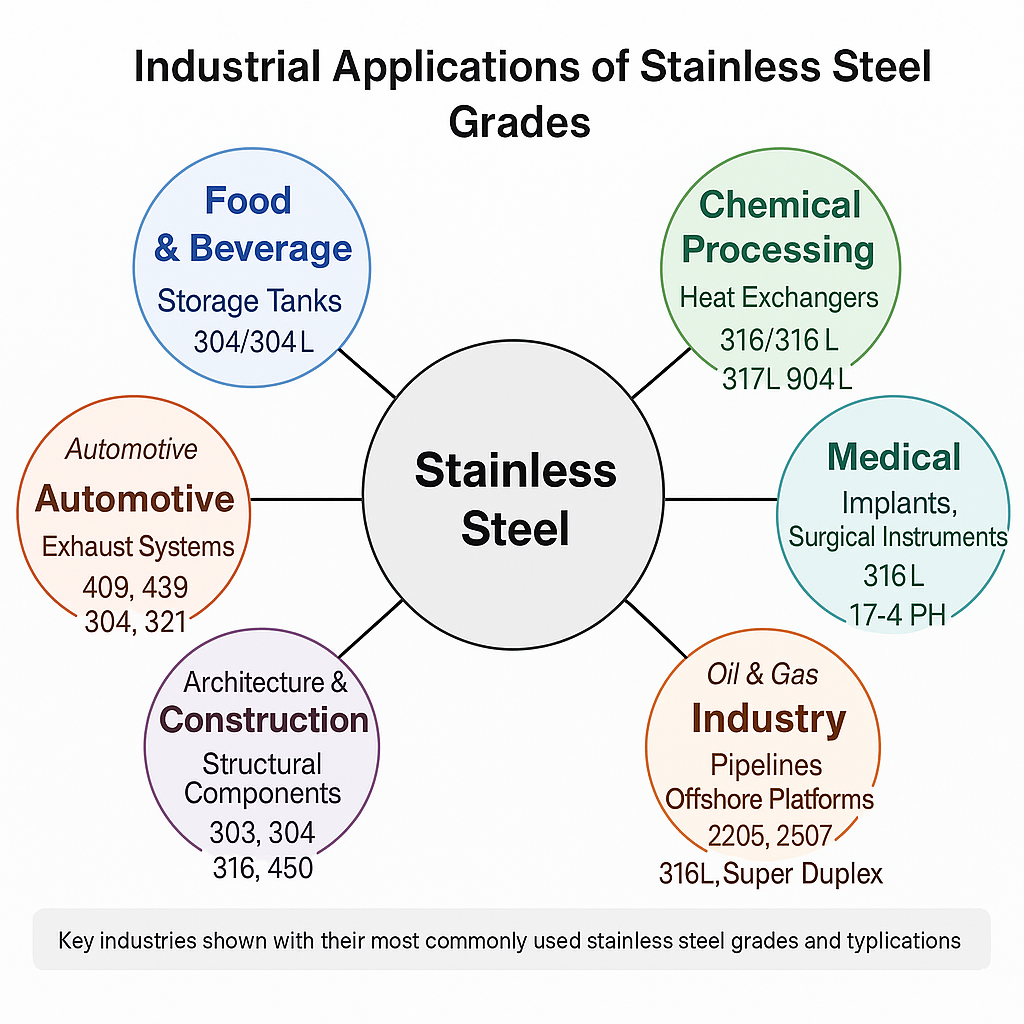
Let’s look at how these grades are used in some of Kanpur and Uttar Pradesh’s key industries.
Food Processing Industry
- 304 Stainless Steel: Ideal for general food handling and preparation equipment, thanks to its corrosion resistance and ease of cleaning.
- 316 Stainless Steel: Recommended for processing acidic foods, dairy products, or where the equipment is exposed to harsh cleaning chemicals.
The FSSAI recommends stainless steel for food contact surfaces due to its non-reactive nature and ability to be thoroughly sanitized.
Chemical Manufacturing
- 316/316L Stainless Steel: Preferred for moderate chemical environments, offering excellent resistance to acids and chlorides.
- Special Alloys: For extreme chemical exposure, higher-alloyed or duplex grades may be necessary.
The Indian Chemical Council provides guidelines for material selection to ensure product purity and safety.
Architectural Applications
- 304 Stainless Steel: Ideal for indoor applications, including handrails and decorative features.
- 316 Stainless Steel: Best for outdoor installations, especially in urban or coastal environments where pollution and salt can accelerate corrosion.
Automotive Components
- 430 Stainless Steel: Commonly used for decorative trim, exhaust systems, and other non-structural parts.
- Specialized Grades: For high-performance or safety-critical components, other grades may be specified.
Testing and Verification
At Aman Metals, we strongly recommend verifying the grade of stainless steel before making major purchases. Here are some common testing methods:
- Optical Emission Spectroscopy (OES): Analyzes the chemical composition of the metal.
- X-ray Fluorescence (XRF): Quickly identifies the elements present in the alloy.
- Chemical Spot Testing: Simple tests to check for specific elements like nickel or molybdenum.
- Magnetic Testing: Austenitic grades (like 304 and 316) are generally non-magnetic, while ferritic and martensitic grades are magnetic.
All our stainless steel products are supplied with test certificates and adhere to the Bureau of Indian Standards specifications.
Stainless Steel Grades at a Glance
Here’s a quick reference table summarizing the most common stainless steel grades and their typical uses:
Grade | Family | Key properties | Typical applications |
304 | Austenitic | Excellent corrosion resistance, formable, weldable | Food processing, kitchenware, architecture |
316 | Austenitic | Superior corrosion resistance (chlorides), heat resistant | Chemical, pharmaceutical, marine, food |
430 | Ferritic | Good corrosion resistance, magnetic, affordable | Automotive trim, appliances, kitchenware |
420 | Martensitic | High hardness, moderate corrosion resistance, magnetic | Knives, cutting tools, surgical instruments |
2205 | Duplex | High strength, excellent corrosion resistance | Chemical processing, pipelines, structures |
Stainless Steel wholesaler in Kanpur and Uttar Pradesh
Kanpur stands out as a prominent industrial center in Uttar Pradesh, recognized as a key player in the supply and fabrication of stainless steel. At Aman Metals, we offer a wide range of stainless steel products, including sheets, wires, bars, and custom components, in grades such as 201, 304, 316, 420, and 430. All our materials are sourced from top manufacturers like Jindal Stainless Ltd. and come with full quality certifications.
We understand the unique requirements of industries in Uttar Pradesh, from food processing and chemicals to automotive and construction. Our team is always ready to help you select the right grade, thickness, and finish for your specific application.
FAQ's ?
Q: What sets 304 stainless steel apart from 316 stainless steel?
A: 316 contains molybdenum, which gives it better resistance to corrosion from chlorides and acids. Use 316 in harsher environments, such as chemical plants or coastal areas.
Q: Is stainless steel magnetic?
A: Austenitic grades (304, 316) are generally non-magnetic. Ferritic (430) and martensitic (420) grades are magnetic.
Q: How do I verify the grade of stainless steel I'm buying?
A: Ask for test certificates, or use methods like XRF analysis, OES, or magnetic testing. Reputable suppliers like Aman Metals provide full documentation.
Q: Can stainless steel rust?
A: While stainless steel is highly resistant to rust, it is not completely immune—especially if the protective chromium oxide layer is damaged or if the steel is exposed to extremely harsh conditions.
Q: Which grade is best for food processing?
A: 304 is suitable for most applications, but 316 is preferred for acidic foods or where harsh cleaning chemicals are used.
Conclusion
Choosing the right stainless steel grade is vital for the performance, longevity, and cost-effectiveness of your products or infrastructure. Each grade has been developed to fulfill specific requirements—from the everyday toughness of 304 to the chemical resistance of 316, the cost-effectiveness of 430, the hardness of 420, and the strength of 2205 duplex.
As a trusted stainless steel supplier in Kanpur, Aman metals is dedicated to providing expert assistance to businesses throughout Uttar Pradesh, ensuring informed decisions regarding stainless steel needs. Our focus on quality, local insights, and a comprehensive product range truly distinguishes us in the industry.
For tailored requirements suited to your specific application, reach out to our product team at our company. With decades of collective experience supporting various industries across Uttar Pradesh, we’re perfectly positioned to help you find the right stainless steel solution.